Case study 03
Smashbase.gg
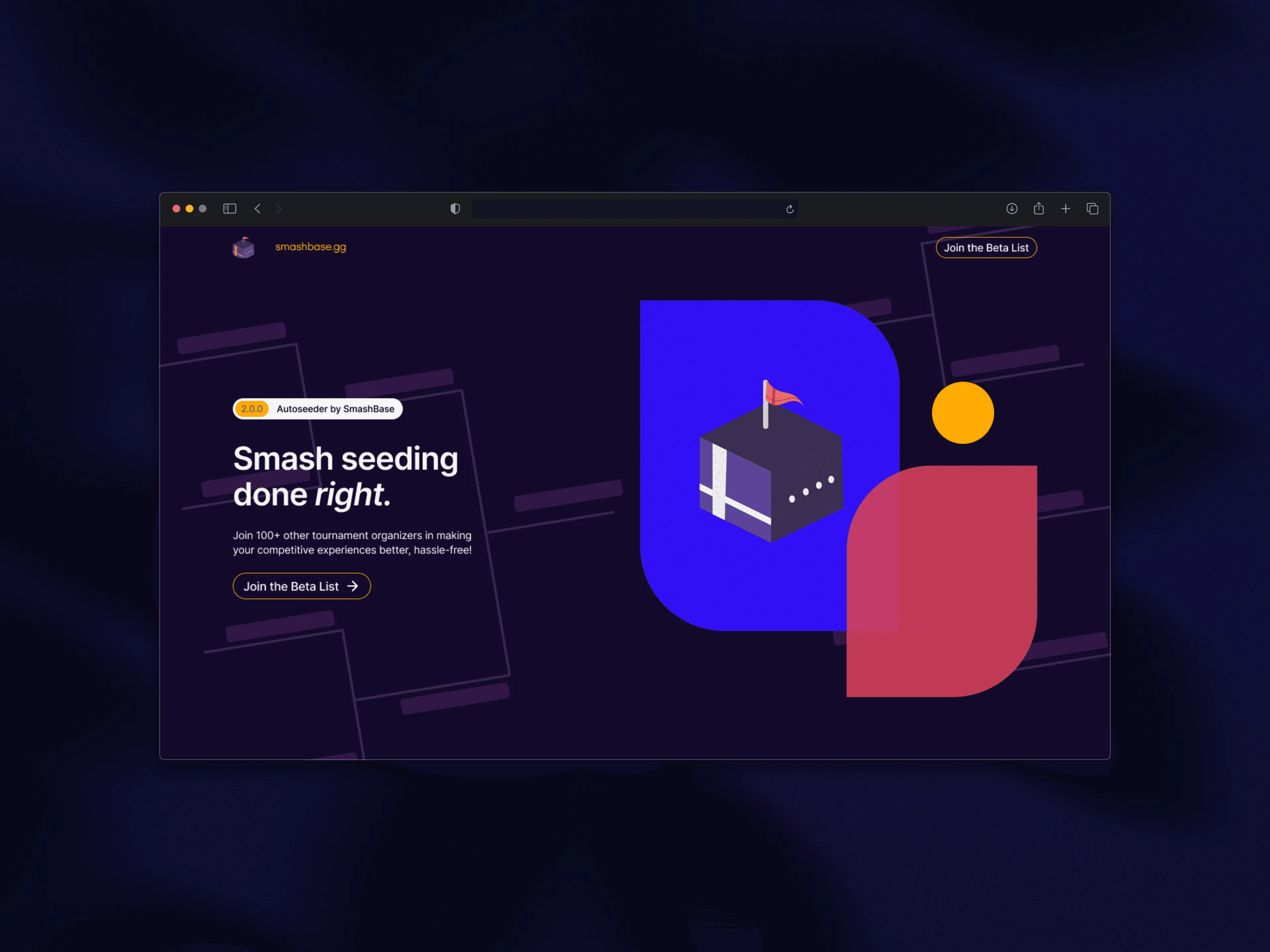
Seeding a major used to take a team of seven organizers up to 20 hours. Smashbase does it in minutes, and organizers trust the result.
The problem
Good seeding means solving for several things at once.
Smashbase pulls tournament data from Start.gg and seeds Super Smash Bros. Ultimate brackets automatically. Putting the best player at seed 1 is the easy part. A fair bracket has to stay balanced all the way down, but organizers had limited time, so most of it went to the top cut.
Skill
Seed by actual skill
Go by results instead of gut feeling or name recognition.
Travel
Keep carpools apart
Players who traveled together shouldn’t meet in the early rounds.
Hidden talent
Strong players the local scene doesn’t know yet, like dominant online players, shouldn’t be badly underseeded.
Variety
At locals, players who face each other every week get split up so competition stays fresh.
Research
What tournament organizers told us.
I wrote a discussion guide so the whole team could run consistent interviews, and we talked to organizers at every scale: international majors like Collision, Wavedash and Tera in France, regional events, small college scenes across the US, and Team Mana in the UAE, Saudi Arabia and Qatar.
New to the tools
Many weren’t technical, and Start.gg’s learning curve kept new organizers out.
Self-taught
Even experienced organizers had never formally learned seeding concepts.
Final say
Every organizer wanted the last word. Nobody was going to trust a black box.
Key design decisions
Easy enough for a first-time organizer, clear enough to trust.
01 A five-step wizard
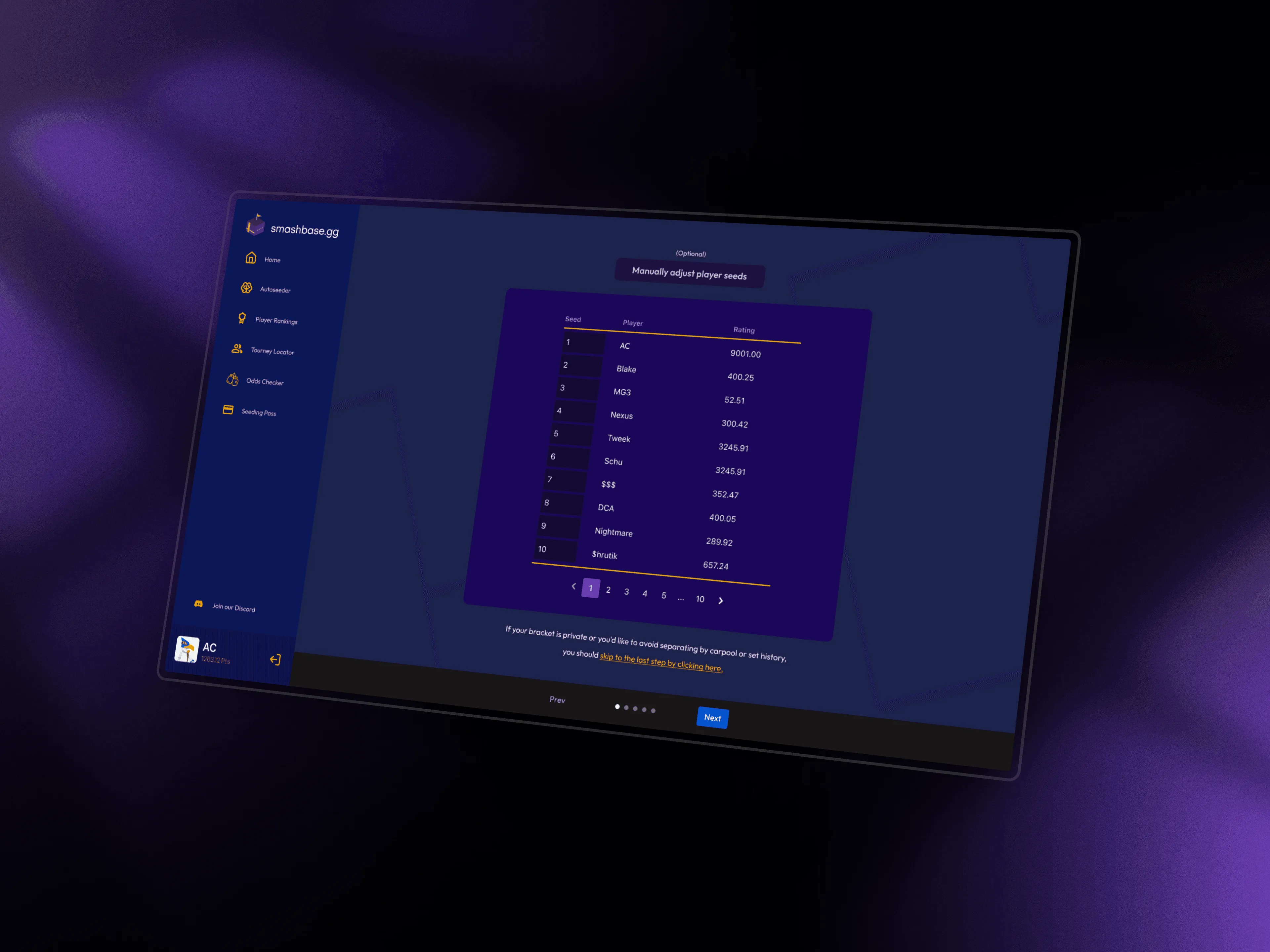
Pick the event, pick the tournament, adjust starting seeds by drag and drop or numbers, set carpools and separation, then review and submit. An organizer can tap through every screen without touching an input and still get a high-integrity result, even on a phone, under pressure.
02 A seeding diff to beat distrust
The review step shows who moved up, who moved down and by how many spots, plus a summary of swaps made for location, set history and carpools. It cleared up a real misunderstanding: some organizers thought separation was broken, when the algorithm was choosing not to distort the bracket.
Seeding diff
Example data- 1MkLeo
- 2acolaset history↓ 1
- 3Sparg0set history↑ 1
- 4Tweekcarpool↓ 1
- 5Lightcarpool↑ 1
- 6Glutonny
03 Fighting for drag and drop
Drag-and-drop seeding came up again and again as a favorite. It was hard to build and easy to cut. I pushed for it and did the research to help the dev team implement it.
The algorithm
Every rule is a tradeoff we chose on purpose.
No placements
Set results instead
Placements are distorted by upsets and bracket luck. Set results are far more accurate.
Sets over games
The set is what counts
Games that didn’t match the set result are discounted for top-level seeding.
Time decay
Old results lose weight, so legacy players can’t coast on past wins.
Online sets count for 1% of an offline set, and defaults adapt to the event: locals favor variety, majors favor strict skill-based seeding. Organizers can override anything, but most don’t need to. We ran the algorithm against human-seeded majors and shared the comparison publicly.
Outcomes
Trusted from weekly locals to international majors.
Events seeded
3,657
Tournaments seeded in the year after the 2023 launch.
Majors
10 / 36
Majors seeded with Smashbase in its first year.
Big online events
12 / 12
Every big online event that year.
Reflection
The community’s values were a design requirement.
Smashbase worked because we took what the community cares about as seriously as the functional requirements. The wizard, the seeding diff and the public stats all existed to make organizers confident enough to hand over a job they’d always done by hand.
There’s still work to do: legacy players can be rewarded a little more than they should be, and we’re still tuning the time decay.